
East/West AIpha · Edition 5 · Tuesday, August 18, 2026 · Day 1016
Automate Work, Amplify Life. East/West AI, for the people betting real capital and real careers on it.
Start in Tianjin, in the Hexi district, inside the 空天数字产业园 Aerospace Digital Industrial Park. On August 13, 时耘科技 Shiyun Technology rolled its first batch of RD3 Ultra humanoids off the line. There was a ceremony. Two robots boxed for the cameras, danced, and performed tai chi, and the clip went out on the wires within hours (FTV/Reuters; Tianjin Daily).
So no, China does not skip the demo. It just does not stop there. Behind the ceremony was the part nobody filmed: a line, a test rig, and a shipping door. CEO 曹克乾 Cao Keqian named the target. Ten standardized application scenarios this year. Scaled delivery in 2027.
That is the difference, and it is the whole edition.
The Alpha
The race everyone watches is the race for the smartest model. The race that moves more capital over the next decade is the race for the body that carries it. On the body, China has already lapped the field.
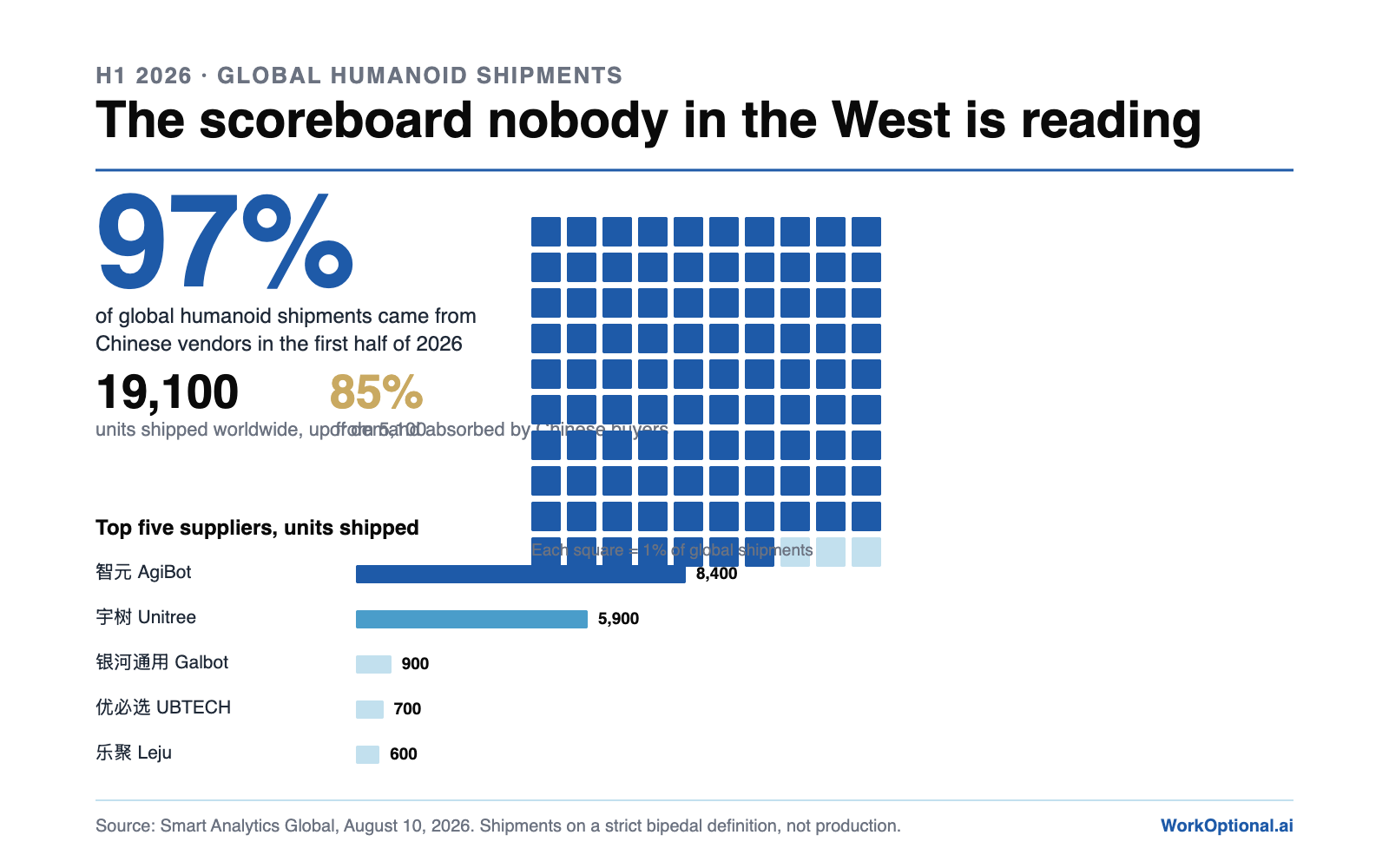
The one number: Chinese vendors shipped more than 97% of the world's humanoid robots in the first half of 2026 (Smart Analytics Global). Not 60%. Not a lead. Ninety-seven percent.
The West still leads the brain. 英伟达 Nvidia's robot compute, Google DeepMind's vision-language-action models and Figure's Helix stack are where general-purpose capability is being built. That moat is real, and this issue does not pretend otherwise.
The East owns the body, and the buyers. Global shipments more than tripled to roughly 19,100 units, from about 5,100 a year earlier. Chinese buyers absorbed more than 85% of them. More than 70% went into industrial and commercial use, up from about half a year ago (Smart Analytics Global).
Then two things happened in the space of three weeks that most Western allocators have not connected. Washington closed its door to Chinese robots. Shanghai opened one, and 宇树 Unitree walked through it at a 66 billion dollar valuation.
If you read only this far: the AI capex debate is fixated on data centers and tokens. The physical layer is where China turned a decade of manufacturing into an AI-era lead. It is now being priced in Shanghai, not New York.
1. The scoreboard nobody in the West is reading
H1 2026 global humanoid shipments. Source: Smart Analytics Global, August 10, 2026.
Names matter, so here they are. 智元 AgiBot overtook 宇树 Unitree as the world's largest humanoid supplier by shipments. AgiBot moved about 8,400 units in the first half, roughly 44% of the global market. Unitree took second at 5,900 units and 31%. Together the two are about three-quarters of the world (Smart Analytics Global).
Behind them the tail is Chinese too. 银河通用 Galbot shipped about 900 units, 优必选 UBTECH about 700, 乐聚 Leju about 600.
These are not lab demos. AgiBot rolled its 15,000th embodied robot off the line on June 28 (Gasgoo). Unitree says it has now built about 18,000 bipedal humanoids in total, wheeled platforms excluded (Unitree, via Gasgoo). 中联重科 Zoomlion is one of China's largest construction-machinery makers. In January it said it runs dozens of its own humanoids in Changsha, in factory logistics, loading, pre-assembly and quality inspection (Zoomlion).
One number worth pausing on. China's humanoid output passed 40,000 units in the first half, against roughly 20,000 in all of 2025 (MIIT, via Gasgoo). Read that against 19,100 global shipments. Output counts units built. Shipments count units delivered.
Depending on which definition you use, China built somewhere between 1.3 and 2 times as many humanoids in six months as the world bought. The uncertainty is not a footnote. It is the point.
Figure | What it counts | Source |
19,100 units | Global shipments, strict bipedal definition | Smart Analytics Global |
30,000+ units | China shipments, wheeled platforms included | HRAA via CMRA |
40,000+ units | China production output | MIIT via Gasgoo |
None of these is wrong. They answer different questions. Any headline quoting one without naming the definition is selling you a number, not a fact.
The gap between built and bought is either a supply chain running ahead of demand, or it is inventory. Chinese trade press has already started asking the second question out loud.
2. The week the body got a price
On August 19, 宇树 Unitree listed on Shanghai's STAR Market. It raised about 900 million dollars at a 9 billion dollar valuation. It closed its first day up more than 460%, worth roughly 66 billion dollars (Fortune; CNN).
Hold that number against a Western comparison. Figure AI, the most valuable US robotics company, was marked at 39 billion dollars in September 2025. A Hangzhou company founded in 2016 is now worth more than Baidu.
The fundamentals are smaller than the headline. Unitree booked 1.7 billion yuan of revenue in 2025, about 252 million dollars, and 600 million yuan of profit. Most of those robots went to research buyers, not factories. Mainland regulators also deliberately price IPOs low, so a first-day pop is closer to tradition than to a verdict.
Two facts from the prospectus matter more than the pop. Roughly 45% of Unitree's 2025 revenue came from overseas. About 18% came from the United States.
3. Why the body is the under-owned trade
Where each side owns the layer. Rare-earth share: IEA, 2024 data.
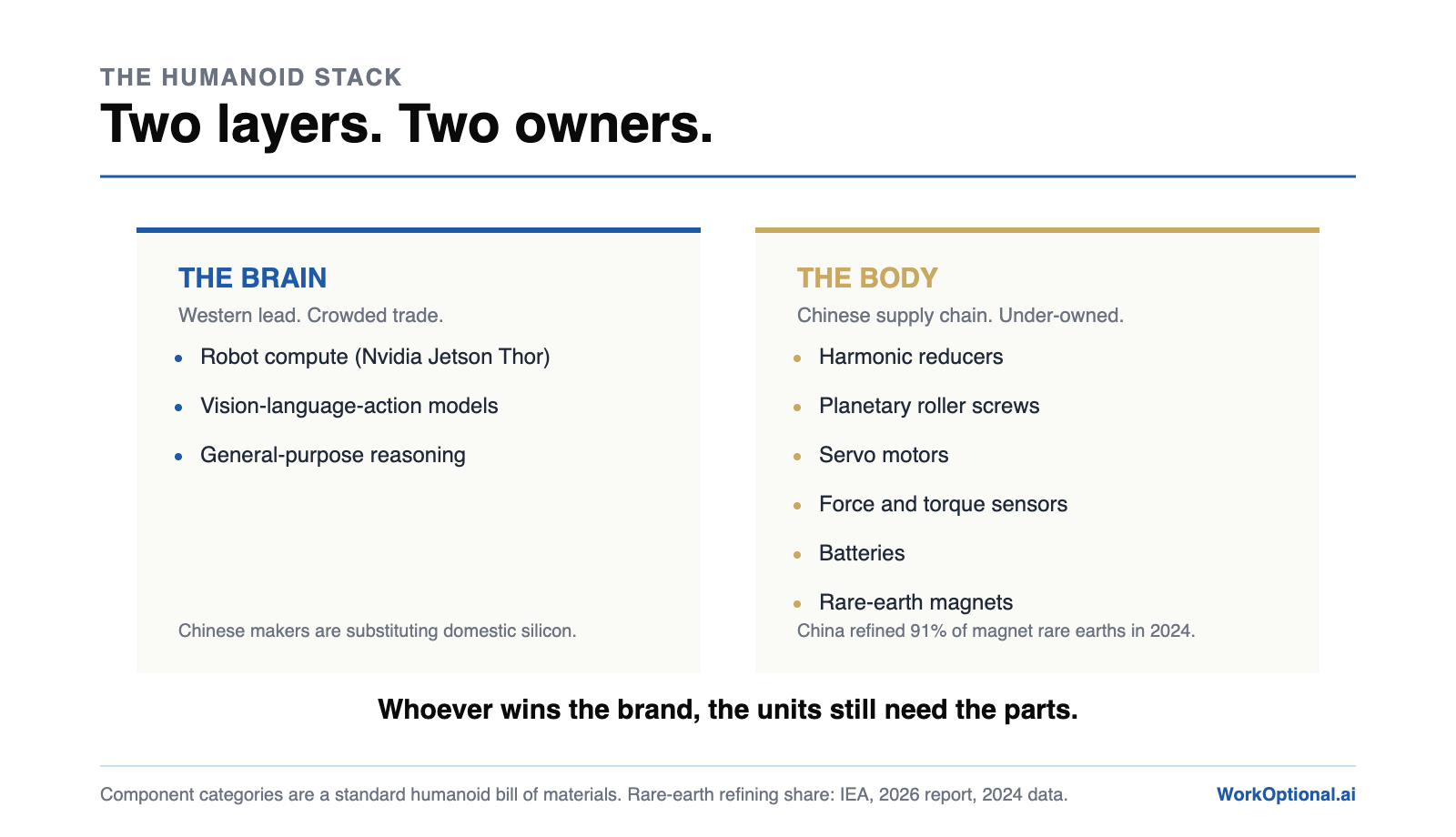
The AI trade priced so far is almost entirely the brain: model labs, GPUs, data centers, power. That trade is crowded and, as we argued in Edition 4, financed increasingly on faith. The body behaves differently.
A humanoid is a bill of materials. Harmonic reducers, planetary roller screws, servo motors, force and torque sensors, batteries, rare-earth magnets. China does not merely assemble these. It refined about 91% of the world's magnet rare earths in 2024 and made 94% of sintered permanent magnets (IEA). Whoever wins the robot brand, the units still need the parts.
It is now industrial policy. China's 15th Five-Year Plan, covering 2026 to 2030, names embodied intelligence a new economic growth point (SCIO). In June, MIIT and the state-assets regulator SASAC launched a real-scenario program. The target is the capacity to deploy at 10,000-unit scale by year-end, plus more than 100 validated scenarios. Every province picks at least 20. Every central SOE picks at least 10 (MIIT; SCMP).
The market underneath grew from about 213 billion yuan in 2018 to an estimated 1.09 trillion yuan in 2026. That is roughly 160 billion dollars, compounding near 22.6% a year (Chinese industry-research estimates, via SCIO). If you run an industrial, logistics or manufacturing business, your future automation vendor list is being written now. Much of it is being written in Chinese.
State-backed demand of that shape does not wait for the technology to be elegant. It buys early, at volume, and lets the supply chain learn on the job. That is how the solar and EV cost curves were bent.
4. The counter-case, because we label it
Washington shut the door. On July 29 the FCC banned new imports of foreign-made humanoid and quadruped robots on national-security grounds. Devices already sold are exempt, and there is a waiver path through the Department of War or Homeland Security (The Robot Report). For Unitree that puts about 18% of revenue in question. Read the allocator advice below against that fact, not around it.
The ban cuts both ways. As robotics advisor Georg Stieler put it, excluding foreign products is not the same as building a competitive industrial base. American robotics startups are reportedly now carrying Chinese components home in their luggage.
The shipment surge may be softer than it looks. HSBC analysts wrote in mid-July that the surge in shipments could be illusionary. Without a real step up in the AI models inside these machines, they do not expect the upcycle to hold.
Volume is not victory. The 97% figure partly reflects how few Western units have shipped at all. The 85% domestic-demand share says the same thing from the other side: this is still largely a home market. And the definitions are contested, as the table above shows.
Timelines are long. Lou Lingtong, who runs an intelligent-sewing company in Zhejiang, frames 2026 to 2028 as a validation phase, one narrow task at a time. He does not expect broad multi-task deployment until 2028 to 2030 (Xinhua). That is one manufacturer's view from one industry, and it is the most concrete timeline anyone has put on the record.
The brain still gates the body. A machine that walks is not a machine that works. General-purpose reasoning is where the West is ahead. Even here the picture is shifting. 优必选 UBTECH now has a chip joint venture in mass production. It says overseas chips can run to a third of a robot's bill of materials (Seoul Economic Daily).
Two things can be true. China has won the manufacturing round decisively. It has not proven it can earn a durable margin on it. Solar is the cautionary precedent as much as the bullish one. China took that industry and then spent years in a price war that destroyed returns for nearly everyone in it.
Top 3 moves this week
1. Unitree lists at 66 billion dollars (East). The body layer now has a public comparable, and it printed above every US robotics private mark. Watch whether the second week holds the first day.
2. The FCC bans foreign-made humanoids (West, policy). The largest Western market just became conditional for Chinese vendors. It also cut US builders off from the cheapest platforms available.
3. AgiBot takes the global crown (East). The volume leader in the defining hardware of the next decade is Chinese, and it happened outside Western portfolios. AgiBot is reportedly preparing a Hong Kong listing of its own.
Commandment 2: Know What You Own
From my book, Ten Commandments of Investing. It sounds obvious until a theme goes viral. This week the temptation is to buy the robot. A brand, a demo, a ticker with a humanoid in the deck. That is owning the story. Knowing what you own means tracing the humanoid down to its bill of materials and asking a colder question. When a hundred thousand of these ship, who sells the harmonic reducer, the servo motor, the sensor, the magnet? From which country? And can they charge for it? The answer is uncomfortable for a Western allocator, and that is the point.
The East/West read
For allocators: underweight the demo, overweight the deposit. The mispriced leg is components and materials, not the brand on the chest plate. But size it for the FCC ban, and do not assume a 460% first day is a valuation.
For operators: your automation roadmap now has a Chinese dependency whether you planned one or not, and a US import rule that may block it. Map both before your competitor does.
For builders: generality is the Western moat. Do not try to out-ship China on units. Win on the brain, the one-robot-many-jobs layer. Partnering for the body just got harder, which is exactly why the firms that solve it early will compound.
One ask
When the humanoid decade is priced, will you have owned the robot, or the parts inside it? If you allocate into robotics, industrials, semiconductors or the components chain, reply to this email. Same if you run a company weighing a humanoid pilot. Tell me what you are building. I read every reply.
San
San Eng is a WSJ and USA Today best-selling author and an institutional investor with more than 500 million dollars deployed across East and West. East/West AIpha exists to give allocators both halves of the AI picture.
On the data in this edition. Every figure is sourced and linked, and every link was fetched and read against the claim it supports. That is not the same as certainty. Shipment, production and market-size figures come from different bodies using different definitions, and they do not reconcile to one number. Where they conflict, all three are shown. The Unitree figures are one trading day old and a first-day price is not a valuation. Currency conversions use the August 2026 rate. Click through before acting on any of it.
Disclaimer. East/West AIpha is published by WorkOptional.ai LLC for information and education only. Nothing here is investment, financial, tax or legal advice, a solicitation, or a recommendation to buy or sell any security. The author may hold positions in securities discussed. Past performance does not guarantee future results. Consult a licensed financial adviser before acting on anything published here.
WorkOptional.ai · Bangkok · Research, Educate, Invest
