
In partnership with

Speak naturally. Send without fixing.

Wispr Flow turns your voice into clean, professional text you can send the moment you stop talking. Not rough transcription you have to clean up. Actual polished text — ready for email, Slack, or any app.
Speak the way you think. Go on tangents. Change your mind mid-sentence. Flow strips the filler, fixes the grammar, and gives you text that reads like you spent five minutes writing it.
89% of messages sent with zero edits. Millions of professionals use Flow daily, including teams at OpenAI, Vercel, and Clay. Works on Mac, Windows, and iPhone.
East/West AIpha · Edition 4 · August 11, 2026 · Day 1009 · WorkOptional.ai
Ten years to sharpen one sword.
The Alpha
My AI subscription ledger reads like a resignation letter to Silicon Valley. I started on GPT, moved to Gemini premium, paid for Perplexity premium and killed it. My Claude plan went $200 a month to $100 to $20, and I am weighing zero. Town.com, once $200, is down to $50. The only line climbing is Kimi: much longer effective context, extremely fast in my actual workflows, far cheaper. I voted with my wallet before I understood what I was voting for. This edition is the story of what I voted for.
I am not alone. Chinese models reached roughly 61% of token share on OpenRouter as of February 2026 (Dataconomy).
The man behind the model I migrated to, Yang Zhilin, 34, has spent a decade on one problem: AI memory. On July 16 his company, Moonshot AI, released Kimi K3, the largest open-weight model ever shipped, at roughly half the price of OpenAI’s flagship. Within fourteen days both US labs repriced the tier below their own flagship.
The investable angle: Moonshot closed $3.5 billion at a $35 billion valuation on July 29, co-led by Alibaba and China’s National AI Industry Investment Fund. A $50 billion pre-IPO round closes this month, and a Hong Kong filing is expected within weeks.
1. The founder America left behind
Answer first: the viral Yang Zhilin story is wrong in its details. The verified version is more investable.
Born 1992 in Shantou, Guangdong (Global Times). He held an olympiad-based direct-admission offer to Tsinghua but sat the gaokao anyway, entering as Shantou’s top science scorer, then switched from thermal engineering to computer science and stayed top of his grade (The Paper). Then a CMU PhD under Ruslan Salakhutdinov in four years. His American experience came through internships at Google Brain and Meta AI rather than a permanent role there (FT, via AI Weekly). In 2019 he co-first-authored Transformer-XL, whose cached states “serve as memory” (arXiv), and first-authored XLNet, which outperformed BERT on 20 tasks (NeurIPS).
The band came before the company. He drummed and wrote lyrics in Tsinghua’s Splay, named after a computer-science data structure; lead guitarist Zhou Xinyu later co-founded Moonshot (China News Service). Apple recruited him through an executive reporting directly to Tim Cook, offering a Beijing-office fallback (Beijing News). He declined, because “if he didn’t at least try starting his own company, he would regret it for the rest of his life” (The National). He founded Recurrent AI in 2016 and Moonshot in spring 2023, named for Pink Floyd’s The Dark Side of the Moon turning 50 (BAAI).
What social media got wrong. Yang was never a Silicon Valley employee and never worked on Gemini or Bard. That traces to Moonshot’s unvetted 2023 PR. K3 does not solve memory either: a 1M-token window is capacity, not perfect recall, and persistent memory remains a product-layer problem industry-wide (MemoryLake). The truth is stronger than the myth. Google’s 2024 Infini-attention paper defines itself against Transformer-XL (arXiv), and Andrej Karpathy has repeatedly named memory and continual learning the key unsolved bottleneck (36Kr). Yang’s own framing, from 2023: context length is the new computer’s memory (BAAI). K3 is marketed in China as 押注记忆而非算力, betting on memory, not compute (Winzheng).
2. The machine that repriced the frontier
Answer first: K3 did not beat the closed frontier on intelligence. It collapsed the price of near-frontier intelligence, and that is the durable disruption.
K3 at a glance
Launch / open weights | July 16 / July 27, 2026 (July 17 China time); bespoke Kimi K3 License |
Architecture | 2.8T total / 104B active MoE; 16 of 896 routed experts |
Context | 1M tokens; Kimi Delta Attention |
Source: K3 technical report (arXiv:2607.24653).
K3 scored 57 on the Artificial Analysis Intelligence Index, ranking third globally as of July 17, at $0.94 per completed task versus $1.80 for Claude Opus 4.8 (Artificial Analysis). The two models above it were Claude Fable 5 at 60 and GPT-5.6 Sol at 59, and it topped Arena’s Frontend Code ranking at 1,679 Elo (analysis). Opus 5 scored 61 a week later, so K3 now sits fourth. It also posted the best open-weight score on SWE-bench Verified at 93.4% (Vals). The counterweights, from Artificial Analysis: hallucination regressed from 39% to roughly 51%, output is verbose, first token is slow.
Model | API price per 1M tokens (in / out) | Cost per completed task |
Kimi K3 | $3 / $15 | $0.94 |
GPT-5.6 Sol | $5 / $30 | $1.04 |
Claude Fable 5 | $10 / $50 | $2.75 |
Claude Opus 4.8 | $5 / $25 | $1.80 |
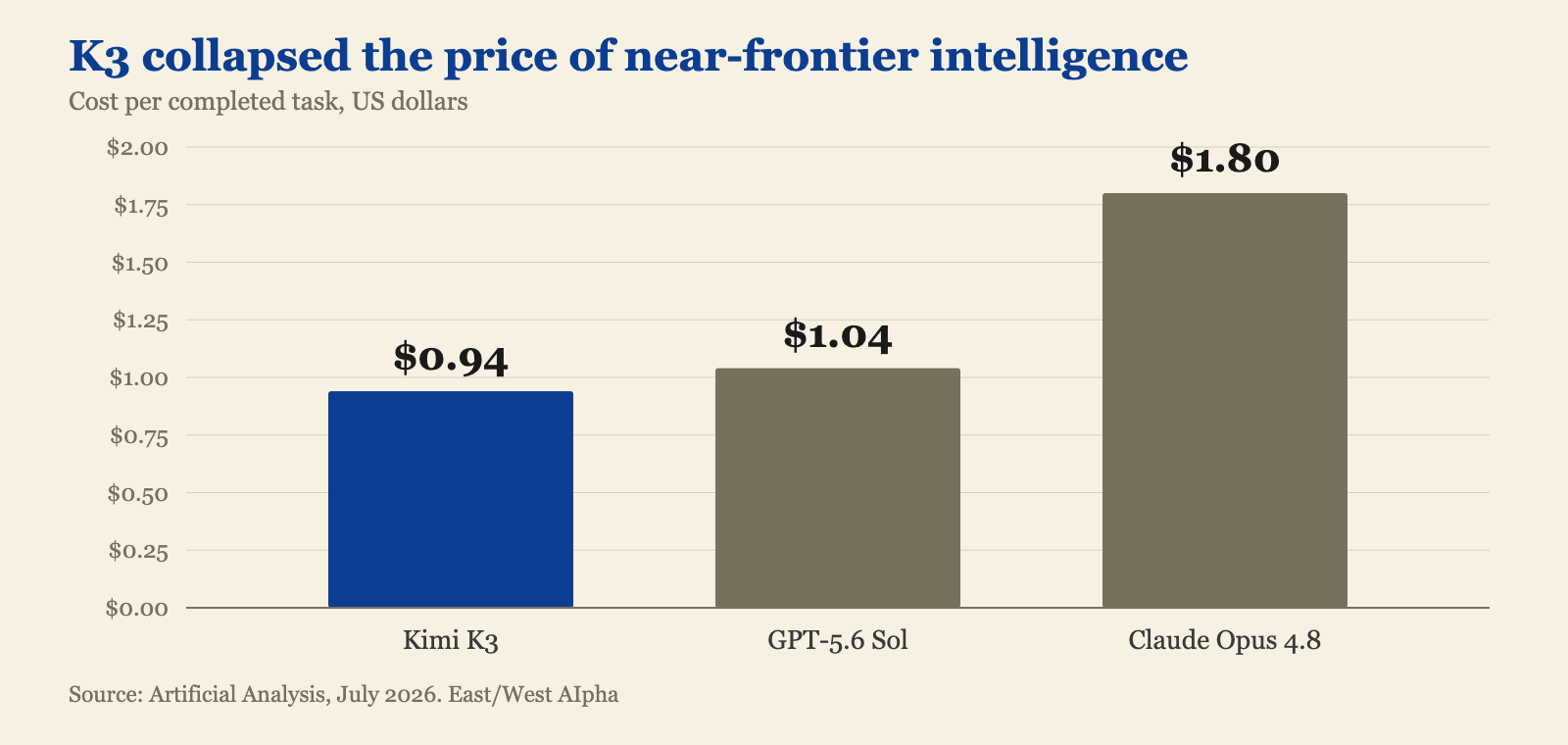
Cost per completed task. Source: Artificial Analysis, July 2026.
The cascade followed, and its shape matters more than its headline. Anthropic shipped Opus 5 on July 24 at half of Fable 5’s price, matching Opus 4.8’s existing rate rather than cutting it. OpenAI cut GPT-5.6 Luna 80% and Terra 20% on July 30, officially for efficiency gains, leaving flagship Sol untouched. Neither lab cut its frontier price. Both made the tier below the frontier cheaper, which is exactly where K3 competes. Chinese coverage ties the two events together directly (ChinaVenture); we would put it more carefully and call the causal link inferred rather than established.
ARR hit roughly $300M in June, tripled in three months, company-relayed and unaudited (AI Weekly/Bloomberg). Meanwhile Kimi’s China app fell to 7.29M MAU, ninth domestically against Doubao’s 382M (199IT/QuestMobile). Moonshot lost the consumer war on purpose. The West reads that MAU table as weakness; it is a margin decision, and my ledger is its prosumer miniature.
3. Beijing picked a champion
Answer first: Moonshot’s IPO is a policy event, not just a financing event. Beijing has designated Moonshot the commercial champion of Chinese AI.
China runs a tiered champion system. DeepSeek took direct state money, with the National AI Industry Investment Fund holding roughly 0.28% (STAR Daily). Zhipu has municipal funds. MiniMax got a market-led listing. Moonshot got capital, platform and the IPO fast lane. That fund, RMB 60.06 billion, was established in January 2025 by MIIT and the Ministry of Finance (Sina), and co-led the July 29 Series F with Alibaba, closing early on strong demand (Caixin/Bloomberg; The Paper).
On April 10, Yang was the only LLM founder among eight speakers at Premier Li Qiang’s economic symposium (Xinhua). The July 13 slot was his fourth appearance on CCTV’s Xinwen Lianbo, and it pre-announced K3’s cadence (Beijing News). Xi Jinping gave the WAIC keynote in person on July 17, his first in-person appearance since the conference launched in 2018, and used it to launch the World AI Cooperation Organization (Xinhua). Stanford DigiChina called the same-day K3 release seemingly coordinated (DigiChina).
Selected rounds
Round | Date | Size | Post-money | Lead(s) |
A | Feb 2024 | $1B+ | $2.5B | Alibaba |
B | Aug 2024 | $300M+ | $3.3B | Tencent |
C / C+ | Dec 2025 / Feb 2026 | n/d | $4.3B / $10B | Alibaba, Tencent |
D | May 2026 | $2B | $20B | Meituan Long-Z |
F | Jul 29, 2026 | $3.5B | $35B | National AI Fund + Alibaba |
G (pre-IPO) | closing ~Aug 27 | TBD | $50B pre-money | invited only |
Sources: Alibaba FY2024 filing coverage; TechCrunch, May 2026 round; Caixin and The Paper above (F); Sina, G.
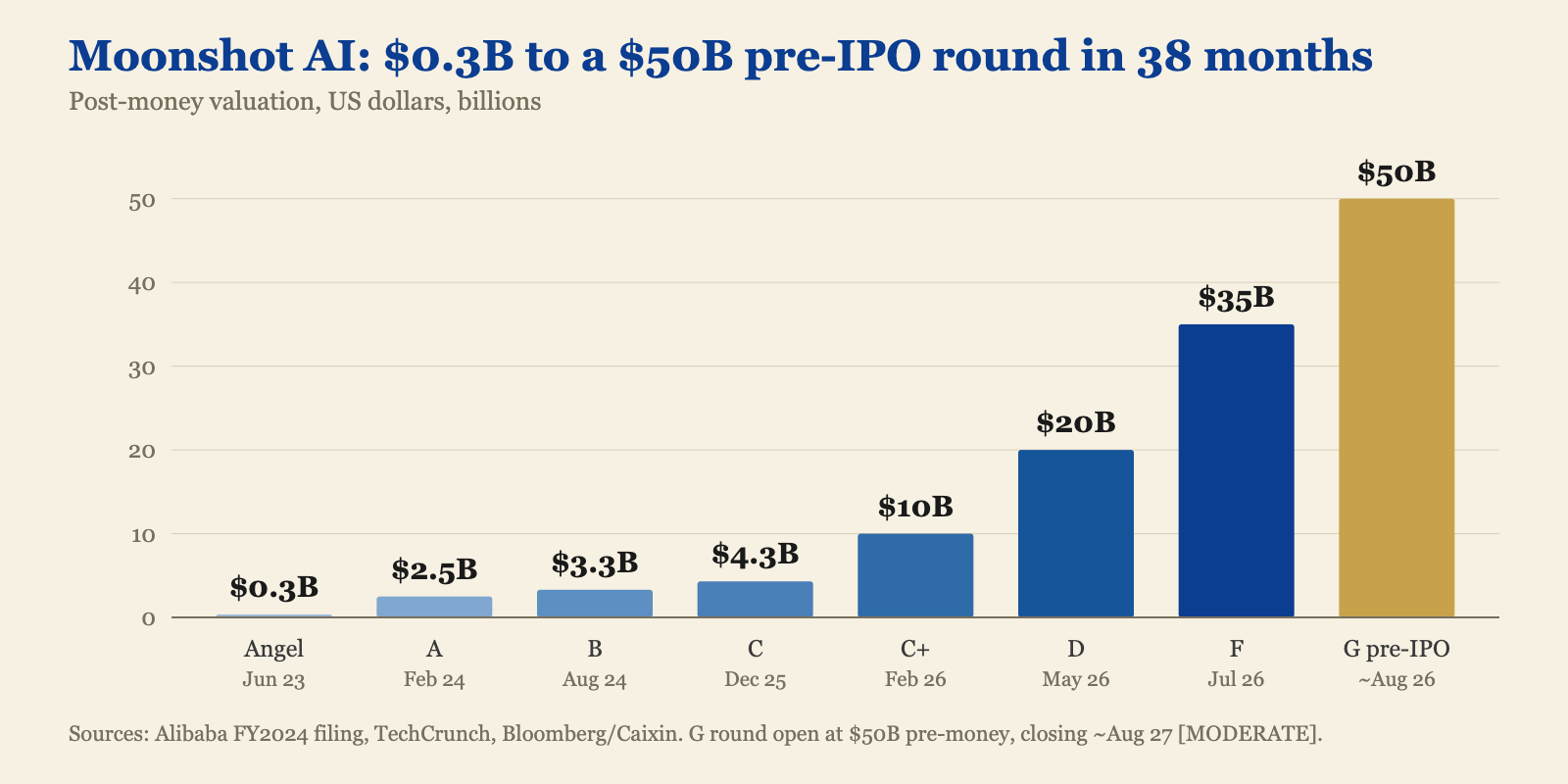
Moonshot AI post-money valuation, angel round to the pre-IPO G round.
Done or scheduled: joint-stock reform July 29; the VIE unwind is under way, with registry updates still incomplete as of August 10; CICC and Goldman Sachs in talks to work on the offering (AI Weekly/Bloomberg); HKEX filing expected before about September 30, per a single Hong Kong brokerage note; listing targeted late 2026 to Q1 2027.
4. How to benefit before the IPO
Answer first: the cleanest risk-adjusted exposure is the proxy with a real business, Alibaba, not the IPO itself.
Voice | Date | The call | Source |
Gavin Baker | Jul 17 | “An important inflection point for AI... net positive for essentially every other company in the world” | |
SemiAnalysis (Max Kan) | Jul 20 | “Selling API tokens may be more profitable than SaaS” | |
JPMorgan | Jul 22 | “DeepSeek 2.0” framing; research arm advised buying the chip dip | |
Morgan Stanley | Jul 17 | “All-around catch-up” in scale, performance and pricing | |
Goldman Sachs | Jul 21 | K3 represents “a new node” in Chinese AI pricing power | |
UBS | Jul 22 | Prefers Alibaba for Qwen 3.8 plus “strategic exposure to Moonshot” |
A note on that table: several of these are Chinese-language secondary reports of Western research notes, not the notes themselves, and the JPMorgan item is carried by an outlet that labels the piece AI-generated. Read the direction, not the decimal.
The BABA proxy math: Alibaba disclosed roughly $800M for about 36% of Moonshot in preferred shares in its FY2024 filing, and still holds roughly 36% preferred with no governance role (36Kr). At $35B, an undiluted 36% is worth $12.6B; applying 25-30% cumulative dilution puts it nearer $8.8-9.5B, which is my own estimate rather than a sourced figure. The caveat that matters: this is under 5% of BABA’s market cap. Moonshot moves the narrative, not the NAV.
Route | Ticker | What you own | Key caveat |
Alibaba | BABA / 9988.HK | ~36% preferred stake plus cloud upside | stake under 5% of BABA market cap |
Tencent | 0700.HK | investor in every round since Aug 2024 | low purity |
Jiuan Medical | 002432.SZ | three-time investor; purest A-share proxy | concept stock, high beta (DoNews) |
Pre-IPO G round | private | $50B pre-money entry | institutions only |
The skeptic math, disclosed. At $35B you pay roughly 117x June ARR. At $50B, roughly 167x, on unaudited revenue. The public comps warn loudly: Zhipu is roughly 65% below its 2026 peak and MiniMax roughly 75% below its March peak near HK$410 billion, though MiniMax rallied 22.8% intraday on August 6 on Stock Connect inclusion (Caixin). K3’s launch day erased 28.5% from Zhipu and 15.6% from MiniMax (Caixin; TMTPost), though MiniMax was already under pressure from a July 9 lockup expiry on roughly 46% of its shares. The Hong Kong window reallocates capital between Chinese AI names rather than creating it.
Risk box. The largest unpriced tail risk is Washington. On July 22 OSTP director Michael Kratsios said the administration had information that Moonshot distilled Anthropic’s Fable model for K3 (Techmeme), and Axios reports Entity List options are on the table (Tomorrow Access/Axios). There has been zero enforcement to date, and researchers dispute whether the distillation claim is even technically feasible, so treat the probability as low and the impact map as clear: an Entity List action would hit the BABA proxy, the IPO and Western API distribution at once. K3’s hallucination regression and leaderboard durability are open questions, and DeepSeek and Qwen responses loom.
The East/West read
For builders: the field’s leaders now call memory the unsolved bottleneck, and the man with the decade-long record ships his architecture open-weight. Build on open weights and metered APIs. The $200 consumer tier is being hollowed from both ends. Follow capability per dollar, not brand.
For allocators: watch price-per-task compression, not benchmark headlines. Margin lost at the model layer is margin gained everywhere else, per Baker. The IPO is a state-staged event, and the risk-adjusted entry is the proxy with a real business, sized for the tail risk above.
Commandment 6: Be Patient, Be Bold
From my book Ten Commandments of Investing, with Howard Marks: “It is not what you buy, it is what you pay for it.” Apply it twice. First, my ledger: I did not switch on hype. My usage data said the price-performance line had crossed, and I pay less for more. Second, the $50 billion question: Moonshot the company is a decade of compounding work; Moonshot the security at 117x unaudited ARR is a different object, and whether to own it depends on what you pay. The founder’s idiom is 厚积薄发 (hou ji bo fa): accumulate deeply, release sparingly. The headline nods to 十年磨一剑, ten years to sharpen one sword. The sword is drawn. Your job is to decide what it is worth.
On the data in this edition. Every figure here is sourced and linked, and every link was fetched and re-read against the claim it supports before publishing. That is not the same as certainty, and we would rather say so than imply a precision we do not have. Private-market valuations, pre-IPO round terms and company-relayed revenue are unaudited by nature. Two Caixin citations are paywalled beyond the opening paragraphs. Several Chinese-language citations are secondary reports of Western research notes rather than the notes themselves, and at least two are published by outlets that label their own pieces AI-generated. Benchmark rankings move within days, and one in this edition already has. Where a number could not be verified independently, that is said in the sentence rather than the number being quietly dropped. This is the best available picture as of August 11, 2026, not a guarantee. Click through to the primary sources before acting on any of it.
Disclosure and disclaimer. East/West AIpha is published by WorkOptional.ai for information and education only. Nothing in this edition is investment advice, a solicitation, or a recommendation to buy or sell any security. The author may hold positions in securities discussed. Private-market valuations and unaudited revenue figures may not reflect realizable value. Past performance does not guarantee future results. Consult a licensed financial adviser before acting on anything published here.
Subscribe free at workoptional.ai. Enterprise readers: email [email protected] with what you do and your size.
WorkOptional.ai · Research, Educate, Invest
